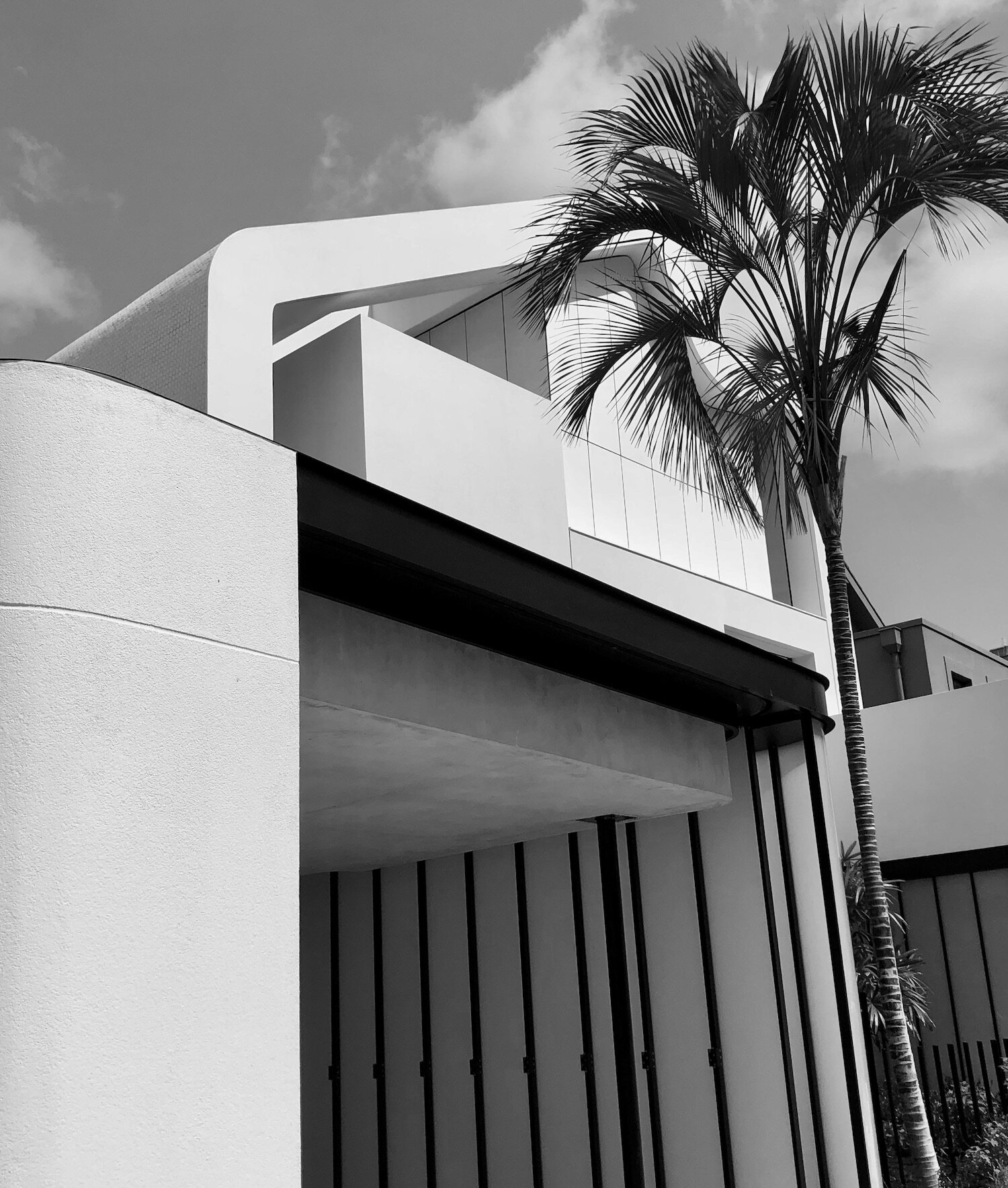
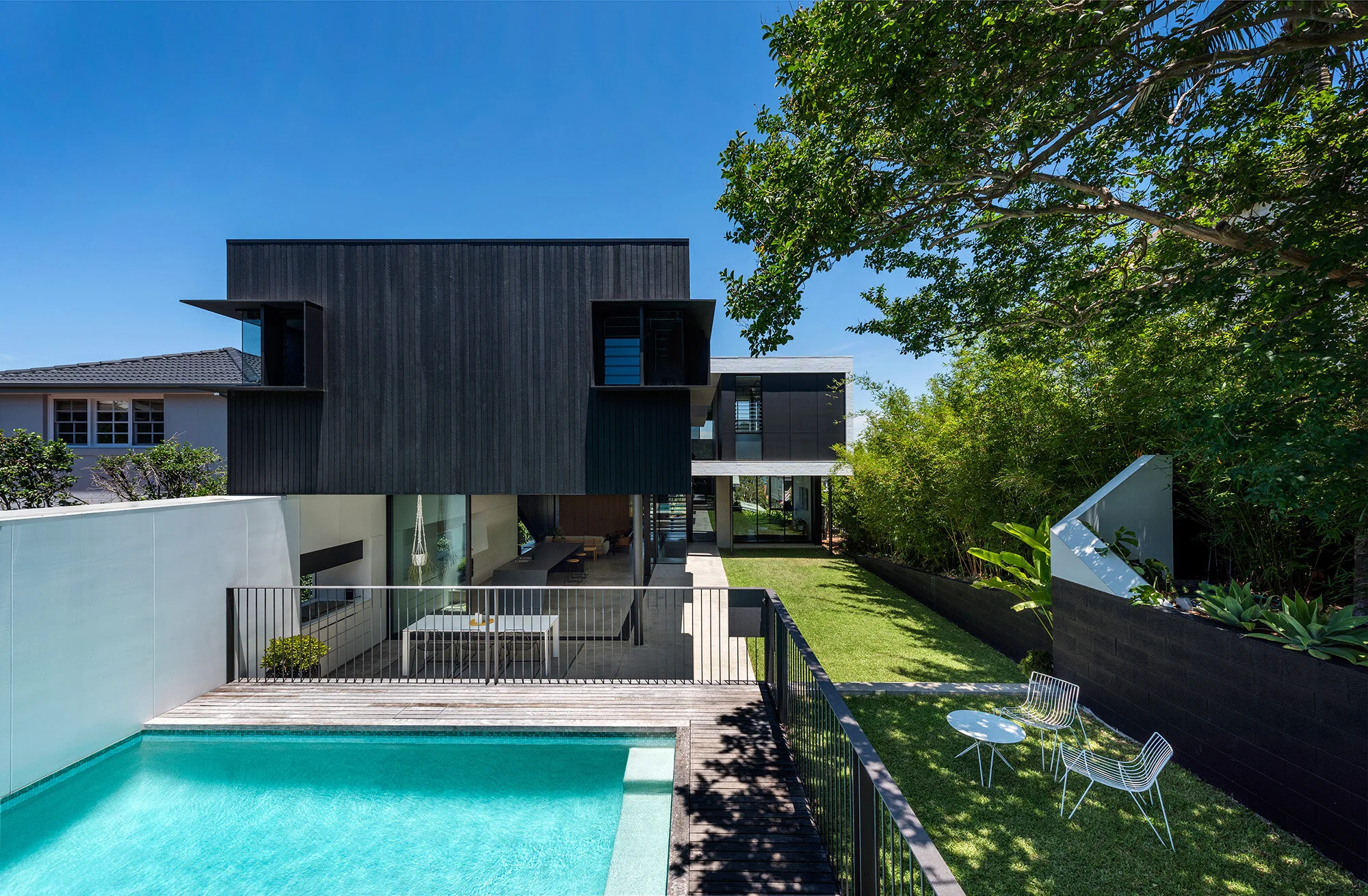
A couple with three boys and extended family came to us with a house on a plot at the foot of Bellevue Hill. Sited across from the golf course at Rose Bay, an inter-war bungalow addressed the street with a fine frangipani, but little else. The option to demolish was taken so that the whole site could be reconsidered for this growing family in a way that would encourage the growing to occur on the site. Fond memories of growing up in another culture, in a home that was essentially one space, formed a strong generating diagram for the site.

The primary ambition for the project is the creation of centralised living space, with boundary defined at the site perimeter, minimising the introduction of any further sense of enclosure.

A linked ambition is that of authenticity in dialogue undertaken with the site. The notion of building with something found is expressed through the solidity and permanence of concrete platforms and hollows, and a fireplace. The relationship of each concrete terrain as it makes its place in or over the site, may be read against a datum drawn at the living platform lodged just on ground. This datum strikes the rim of the deep hollow of the pool, and the rim of the hollows cut for bathrooms and bedrooms.

A single roof plane expresses an elemental form of shelter. This other horizontal datum strikes a counterpoint to the lay of the land and the stepping of the ‘found’ concrete terrain.

Pockets for specific living have been sited for the fall of light across the day. A kitchen courtyard catches the first sun. A pool lies adjacent to the north-oriented living space, casting varied light and air. The boys’ shared area is north oriented, extending directly into the yard. An elevated study enjoys the only view from the site, where the sense of perimeter is extended into the borrowed space of the golf course tree canopy, while protected by a timber screen.

A contribution to the street is made in the screen’s abstract geometry, in the introduction of colour, the modest treatment of garaging, and the visual permeability offered by a low-walled garden serving as transition for entry.

We are fortunate now to work with engineers who are respectful of the architectural intent, and fortunate to know landscape architects happy to leave a yard alone so boys may kick a ball, and be excited by the small prospect of a rooftop grassy knoll. We are fortunate to find a builder who is also an architect, sweating over the expression of the project as much as his carpenters loved the labour of crafting the board-forms for concrete walls.

This house uses principles of cross-ventilation, needs no artificial cooling, and ulitises the thermal mass of concrete, tempered by in-slab, gas hydronic heating. Sustainable plywood and laminated members are used throughout. A modesty of material and scale has been essential in the realisation of this home.


Mallat House